USCG boating safety compliance: clear steps for safer boating
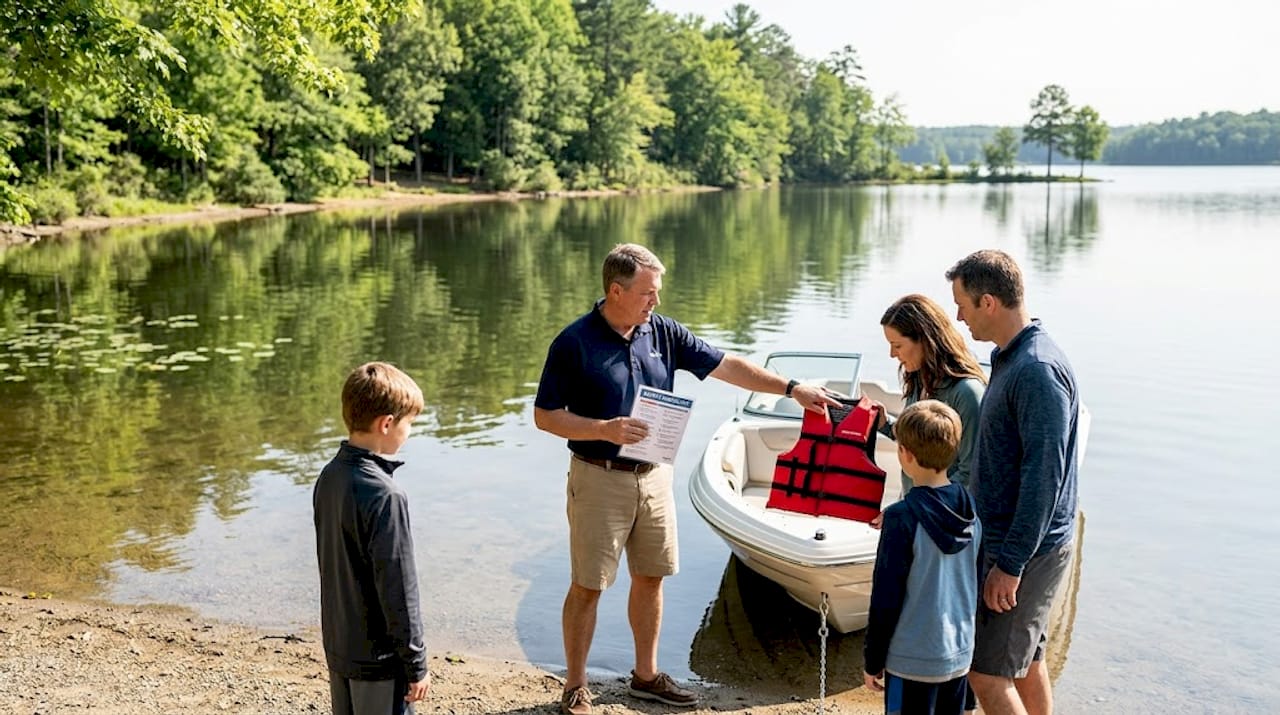
You bought the boat, got the gear, and planned the trip. Then someone mentions federal boating regulations, state education requirements, and USCG-approved equipment lists, and suddenly the whole outing feels more complicated than it should. That confusion is common, and it carries real consequences. Missing a single requirement can mean a fine on the water, an invalid boating certificate, or worse, an unsafe situation with no proper equipment on board. This guide breaks down USCG boating safety compliance into three clear categories: education, equipment, and incident reporting. Work through each one, and you will be legally prepared and genuinely safer on the water.
Table of Contents
-
Step 1: Meet your state’s boating safety education requirement
-
Step 3: Know incident-reporting procedures and documentation
-
Our take: Why USCG boating safety compliance is about more than avoiding fines
Key Takeaways
| Point | Details |
|---|---|
| Know your state rules | Boating safety requirements vary by state, so always check local laws to ensure your course and credentials are accepted. |
| Federal and state equipment | You must have USCG-approved safety gear and may need extra items depending on your vessel and local waters. |
| Education is crucial | Most states require a recognized boating safety course for legal operation and best safety practices. |
| Reporting is part of compliance | Accident and incident reporting are mandatory for full USCG compliance—keep documentation handy. |
| Avoid common mistakes | Double-check certificate recognition and equipment lists to prevent violations and ensure safe boating. |
What does USCG boating safety compliance mean?
USCG stands for the United States Coast Guard, the federal agency responsible for setting minimum safety standards for recreational boating on U.S. navigable waters. Compliance means satisfying those standards, but here is where many boaters get confused: federal rules are the floor, not the ceiling. States can and do add requirements on top of them.
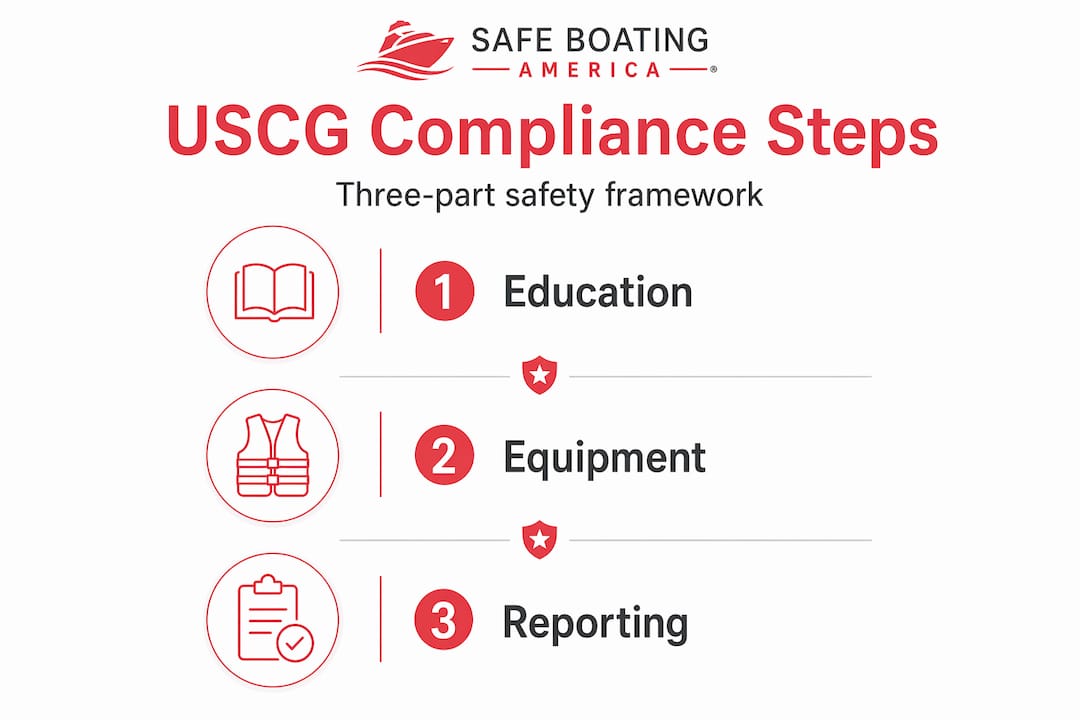
USCG boating safety compliance covers three main categories:
-
Education: Completing a recognized boating safety course that meets NASBLA (National Association of State Boating Law Administrators) standards
-
Equipment: Carrying Coast Guard-approved safety gear on board, sized and typed correctly for your vessel
-
Incident reporting: Knowing when and how to report accidents, injuries, or property damage to the appropriate authorities
Federal and state rules overlap constantly. If you boat on navigable waters, which includes most lakes, rivers, bays, and coastal areas, you are subject to both. The general rule is simple: when federal and state requirements conflict, follow the stricter one.
“When boating across both state and federal waters, always default to the more restrictive requirement. This approach keeps you compliant everywhere and eliminates guesswork at the dock or during a Coast Guard inspection.”
Equipment requirements are especially variable. USCG-approved life jackets (PFDs, or personal flotation devices) are federally required for every person on board, but the type, quantity, and additional gear required change based on vessel length and operating area. A vessel under 16 feet has different requirements than one over 26 feet.
| Vessel length | Required PFDs | Type IV throwable | Fire extinguisher |
|---|---|---|---|
| Under 16 ft | 1 per person | Not required | Recommended |
| 16 to 26 ft | 1 per person | 1 required | 1 required |
| 26 to 40 ft | 1 per person | 1 required | 2 required |
| Over 40 ft | 1 per person | 1 required | 3 required |
Visit the boating regulations overview for a full breakdown of federal and state-specific rules. For general boating safety tips and updates, the boating safety blog covers current topics in plain language.
Step 1: Meet your state’s boating safety education requirement
Most states now require boaters to complete a NASBLA-approved or USCG-recognized boating safety course before operating a motorized vessel. The specific rules vary significantly by state, including which age groups must comply, what type of certificate is accepted, and when new laws take effect.
Here is a step-by-step process for meeting your state’s education requirement:
-
Identify your state’s rule. Look up your state’s boating authority website or check a trusted resource. Requirements differ by age, vessel type, and horsepower.
-
Choose an approved course format. Options include in-person classes, live Zoom sessions, and self-paced online boating courses. All must be NASBLA-approved to count.
-
Complete the course and pass the exam. Most approved courses end with a proctored or supervised exam. You must pass to receive your certificate.
-
Obtain and store your certificate. Your state may issue a physical card, a digital certificate, or a boating endorsement added to your driver’s license.
-
Verify acceptance in your target state. If you plan to boat in multiple states, confirm that your certificate is recognized where you are going.
Massachusetts boating safety education provisions take effect April 1, 2026, under the Hanson-Milone Boater Safety Act, meaning new groups of boaters in that state will soon need to complete approved education before getting on the water. This is a good reminder that requirements evolve, and staying current matters.
Pro Tip: If you are in New York, Brianna’s Law requires all motorized vessel operators to hold a boating safety certificate. Check the New York boating license guide for age-based phase-in dates and exactly what your certificate must include. Connecticut boaters can find similar detail in the Connecticut boating license guide.
| State | Minimum age requirement | Certificate type accepted | Online course available |
|---|---|---|---|
| New York | All operators (phased) | NASBLA-approved | Yes |
| Connecticut | 16 and under | State-approved | Yes |
| Massachusetts | Expanding in 2026 | NASBLA-approved | Yes |
| Florida | Born after Jan 1, 1988 | NASBLA-approved | Yes |
| California | Born after Jan 1, 1988 | NASBLA-approved | Yes |
Course providers vary in quality and recognition. The Coast Guard Auxiliary and America’s Boating Club (formerly U.S. Power Squadrons) offer recognized in-person options nationwide. State-approved online providers are also widely accepted, but always confirm approval before enrolling.
Step 2: Ensure you have the required safety equipment
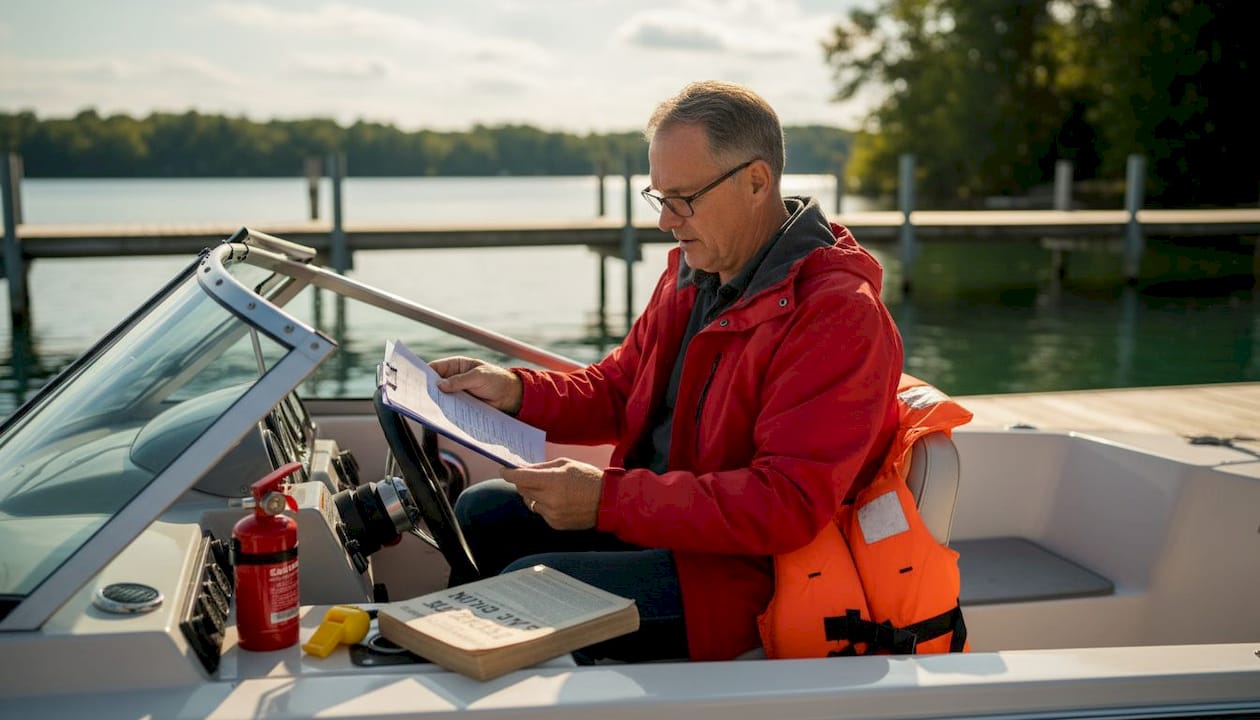
Education gets you certified. Equipment keeps you safe. Federal law requires specific safety gear on every recreational vessel, and states often add to that list. Skipping an inspection of your gear before each trip is one of the most common mistakes boaters make.
Here is the core federal equipment checklist for recreational boats:
-
Personal flotation devices (PFDs): One Coast Guard-approved life jacket for every person on board, in the correct size
-
Type IV throwable device: Required on boats 16 feet and longer; must be immediately accessible, not stored below deck
-
Visual distress signals: Required on coastal waters and the Great Lakes; flares or electronic alternatives
-
Sound-producing device: A whistle or horn is required on all vessels; larger vessels need an electric horn
-
Navigation lights: Required for operating between sunset and sunrise or in restricted visibility
-
Fire extinguisher: Required on most motorized vessels; type and quantity depend on vessel size
Federal equipment requirements vary by vessel size, type, and operating area, and state rules can require additional items beyond the federal minimum. Always check both lists before your trip.
Pro Tip: Buy a laminated equipment checklist and keep it in your boat’s storage compartment. Run through it before every outing, not just at the start of the season. Equipment expires, degrades, and gets moved around. A quick pre-trip check takes five minutes and prevents violations and real emergencies.
| Equipment item | Federal requirement | State additions possible |
|---|---|---|
| PFDs | 1 per person, approved type | Yes, often stricter for PWC |
| Type IV throwable | Boats 16 ft and over | May be required on smaller boats |
| Fire extinguisher | Most motorized vessels | Yes |
| Visual distress signals | Coastal and Great Lakes | Yes |
| Sound device | All vessels | Yes |
| Navigation lights | All vessels (nighttime) | Varies |
When you operate in both state and federal waters during the same trip, carry the equipment required by whichever set of rules is stricter. This protects you from violations regardless of which jurisdiction a Coast Guard or state officer is enforcing. Review the full equipment regulations page to confirm what applies to your vessel and your state.
Step 3: Know incident-reporting procedures and documentation
Most boaters never think about incident reporting until they need it. That is a mistake. Knowing the rules before an accident happens lets you act quickly, protect yourself legally, and help authorities improve safety for everyone on the water.
Federal law requires you to file a report when a boating accident involves any of the following:
-
A person dies as a result of the accident
-
A person disappears from the vessel under circumstances suggesting death or injury
-
A person is injured and requires medical treatment beyond first aid
-
Property damage exceeds $2,000, or there is a complete loss of the vessel
Here is the reporting process step by step:
-
Ensure safety first. Render assistance if you can do so safely. Call for emergency help immediately.
-
Document the scene. Take photos, note GPS coordinates, and record the time and weather conditions.
-
Collect information. Get names, contact details, and vessel registration numbers from all parties involved.
-
Contact your state boating authority. Most states require you to file a Boating Accident Report (BAR) within 48 hours for fatalities or disappearances, and within 10 days for other reportable incidents.
-
File with the USCG if required. Your state authority typically forwards reports to the USCG, but confirm this with your local office.
“Treat education, equipment, and incident-reporting procedures as one checklist. USCG boating safety materials emphasize taking safety instruction and knowing what must be reported after certain incidents. Completing all three areas gives you full compliance and full confidence.”
Keep a written list of emergency contacts in your vessel, including your state boating authority, the nearest Coast Guard station, and local marine law enforcement. Store it in a waterproof bag alongside your registration and certificate. For ongoing boating safety reminders, check updated guidance before each season.
Common mistakes and troubleshooting tips
Even well-intentioned boaters make compliance errors. Most of them are avoidable with a little preparation. Here are the most frequent problems and how to fix them.
-
Assuming your certificate works in every state. Some states have strict rules about which certificates they accept. For example, Tennessee’s boating handbook specifies that Tennessee residents must hold a TWRA-issued certificate, meaning a certificate from another state or a USCG-issued credential may not automatically satisfy Tennessee’s requirement. Always verify before you boat in a new state.
-
Carrying expired or wrong-type equipment. Flares expire. PFDs deteriorate. A Type II PFD does not satisfy a requirement for a Type I in certain operating areas. Check labels and expiration dates every season.
-
Missing the incident-reporting window. Waiting too long to file a report after an accident can result in legal penalties. Know the deadlines before you need them.
-
Not saving your course certificate. If your certificate is lost or unverifiable, you may be treated as uncertified during an inspection. Save a digital copy in your phone and a printed copy in your vessel.
-
Relying on outdated state handbooks. Requirements change. Massachusetts just updated its education law for 2026. Check your state’s current boating authority website at least once per year.
Pro Tip: Set a calendar reminder each spring to review your equipment checklist, confirm your certificate is still valid in your state, and check for any regulatory updates. This 30-minute annual review prevents the vast majority of compliance problems. If you need to update your credentials, alternative boating courses are available online for most states. For specific questions, the boating safety FAQs section covers common compliance scenarios.
Our take: Why USCG boating safety compliance is about more than avoiding fines
Most boaters think about compliance the way they think about a speed limit: something to follow when someone is watching. That framing misses the point entirely.
The three-part compliance framework, education, equipment, and incident reporting, is not bureaucratic overhead. It is a structured system that addresses the three most common ways recreational boating goes wrong. Boaters who do not know the rules make dangerous decisions. Boaters without proper equipment cannot respond to emergencies. Boaters who do not know reporting procedures often make situations worse by acting without a plan.
From our experience working with thousands of students across the country, the boaters who struggle most on the water are not the ones who skipped a specific item on a checklist. They are the ones who never thought about boating safety as a system. They took a course, bought a life jacket, and assumed they were done. Then they encountered a situation that required more: a medical emergency, a collision, a vessel fire, and they were not prepared.
The most confident, capable boaters we have trained treat compliance as a baseline, not a ceiling. They complete their full boating regulations review annually. They know their equipment by type and location. They have talked through what to do in an emergency with every person on their boat before leaving the dock.
There is also a cultural dimension worth naming. When boaters take compliance seriously, they model that behavior for others on the water. They slow down in no-wake zones. They carry properly sized PFDs for children. They report accidents instead of hoping no one noticed. That culture makes the water safer for everyone, including the boaters who are not yet thinking about any of this.
Compliance is not the destination. It is the foundation that makes everything else possible: longer seasons, more confident outings, and fewer emergencies that ruin a good day on the water.
Find USCG-approved boating safety courses and resources
Ready to get your boating safety education completed and your compliance checklist finished? Safe Boating America offers state-approved courses for boaters across the country, from New York and Connecticut to California, Florida, and Texas.
Safe Boating America’s online boating courses are NASBLA-approved and accepted in most states, with live Zoom classes and in-person options also available. Courses are taught by State Certified Instructors and USCG-Licensed Captains, covering navigation rules, required equipment, emergency procedures, and state-specific boating laws. Whether you need a boating safety certificate for the first time or want to update your credentials before the 2026 season, Safe Boating America provides fast, reliable, and legally recognized training. Visit safeboatingamerica.com to find a course that fits your schedule and state requirements.
Frequently asked questions
What is the difference between federal and state boating safety requirements?
Federal guidelines set minimum standards for all navigable U.S. waters, but states can add extra requirements on top of them. Boaters must comply with both, and when the two conflict, federal and state equipment rules require following the stricter standard.
How do I find USCG-recognized boating safety courses near me?
The USCG recommends using the Coast Guard Auxiliary class finder or America’s Boating Club (formerly U.S. Power Squadrons) to locate recognized courses; many are also available online through state-approved providers.
What equipment do I need for USCG compliance?
You need Coast Guard-approved PFDs for every person on board, a Type IV throwable device for boats 16 feet and longer, and additional items like visual distress signals, a sound device, navigation lights, and fire extinguishers based on your vessel size and operating area.
Do all states accept USCG-approved boating safety certifications?
Most states recognize NASBLA-approved courses, but some have unique rules. For example, the Tennessee boating handbook specifies that only a TWRA-issued certificate satisfies Tennessee’s requirement for residents, so a certificate from another state may not automatically count.