
Essential boating electronics for safe and legal operation

Selecting the right electronics for your boat is not a luxury decision. It is a safety and legal compliance decision that can determine whether you return home or trigger a Coast Guard search. Recreational boaters and personal watercraft (PWC) operators face a growing list of state and federal requirements tied directly to onboard electronics, and the wrong gear, or the right gear installed incorrectly, can leave you exposed in an emergency. This guide walks through the core electronics stack, how each device performs, what certification courses teach you about them, and how to maintain compliance every season.
Table of Contents
- Key criteria for choosing boating electronics
- Essential boating electronics for safety and certification
- Comparing must-have electronics: Features and installation tips
- Electronics, education, and ongoing maintenance for compliance
- A smarter approach: Beyond just buying the gear
- Get certified and boost your boating safety expertise
- Frequently asked questions
Key Takeaways
| Point | Details |
|---|---|
| Reliable installation matters | Correct setup and periodic testing ensure your boating electronics work when needed. |
| Certification includes electronics | Boating certification courses teach use of radios, GPS tools, and safety equipment for legal operation. |
| Maintenance is legal and practical | USCG and state rules require ongoing maintenance and documentation for safety electronics like EPIRBs. |
| Electronics need backup | Always pair navigation devices with practical compass and chart skills for redundancy. |
| Compare features for your needs | AIS, GPS, VHF, and other devices vary in update rate and capability, so match your electronics to your boating environment. |
Key criteria for choosing boating electronics
Now that you understand how boating electronics can elevate your safety and certification readiness, let’s break down how to evaluate which equipment is right for you.
Not every device marketed for marine use belongs on your vessel. Choosing correctly means filtering options through three practical lenses: safety function, regulatory compliance, and educational relevance.
Safety function is the starting point. A device earns a place on your boat by performing a specific, documented role in preventing accidents or enabling rescue. VHF marine radio with Digital Selective Calling (DSC), GPS/chartplotter navigation, and Automatic Identification System (AIS) for situational awareness form the core electronics stack for most recreational vessels. Each of these tools addresses a distinct failure mode: communication loss, positional uncertainty, and collision risk.
Regulatory compliance is the second filter. Your state and the U.S. Coast Guard (USCG) impose specific equipment requirements, and those requirements are not static. USCG safety compliance standards are updated periodically, and failing to track changes can result in citations, fines, or worse, inadequate gear during an emergency. Reliable installation and periodic testing are part of compliance, not optional extras.
Educational relevance is the third lens. Boating safety courses teach you to operate these devices correctly. Boating education directly lowers accident rates by connecting equipment ownership to operational competence. Knowing how to trigger a DSC distress call on a VHF radio, for example, is a skill that only formal instruction reliably delivers.
Key evaluation criteria at a glance:
- DSC capability: VHF radios should include DSC for automated distress signaling.
- GPS integration: Chartplotters must connect to a reliable GPS antenna for accurate positioning.
- AIS class: Class B AIS is standard for recreational boats; Class A is for commercial vessels.
- EPIRB registration: Emergency Position Indicating Radio Beacons (EPIRBs) must be registered with NOAA to function in rescue operations.
- PWC-specific gear: Engine cut-off switch (ECOS) lanyards are mandatory for personal watercraft in most states.
“Selecting electronics without understanding their operational requirements is like buying a fire extinguisher and never learning how to use it. The device only helps if you can activate it correctly under pressure.”
Pro Tip: Before purchasing any marine electronics, cross-reference the device specifications with your state’s boating regulations and the USCG equipment checklist. Many states have adopted requirements that exceed federal minimums, particularly for PWC operators. Garmin’s boating safety guidance is a useful starting point for understanding what modern electronics can and cannot do for you on the water.
Essential boating electronics for safety and certification
Let’s look at these electronics individually, highlighting why each is vital for your safety, situational awareness, and certification requirements.
USCG-aligned boating education covers marine radio procedures including distress, urgency, and safety calls, alongside GPS and traditional chart and compass navigation. That curriculum exists because these tools are the backbone of safe vessel operation.
Here are the five essential electronics every recreational boater and PWC operator should understand:
-
VHF marine radio with DSC. Channel 16 is the international distress and calling frequency. A DSC-enabled VHF radio allows you to send an automated distress signal that includes your vessel’s GPS coordinates. Without DSC, a mayday call depends entirely on voice transmission and someone being tuned in. With DSC, rescue coordination centers receive your position automatically.
-
GPS/chartplotter navigation system. A chartplotter overlays your GPS position onto electronic nautical charts, giving you real-time awareness of water depth, hazards, and traffic separation zones. Standalone GPS units work, but integrated chartplotters with sonar and AIS overlay provide far greater situational awareness. Review online boating courses for instruction on reading and interpreting chartplotter data.
-
AIS transponder. AIS broadcasts your vessel’s identity, position, speed, and heading to other AIS-equipped vessels and shore stations. It also receives the same data from other vessels, giving you a real-time traffic picture that radar alone cannot provide in congested or low-visibility conditions. Garmin and Sea Tow’s joint safety initiatives highlight AIS as a priority tool for recreational boaters.
-
EPIRB (Emergency Position Indicating Radio Beacon). EPIRBs are designed for offshore and open-water use. When activated, they transmit a distress signal to the COSPAS-SARSAT satellite system, which relays your position to rescue coordination centers. Maintenance is mandatory, not optional. Check boating regulations for EPIRB requirements specific to your vessel class and operating area.
-
Engine cut-off switch (ECOS) lanyard. For PWC operators, the ECOS lanyard is a life-safety device. Pennsylvania PWC regulations explicitly require a sound-producing device and engine cut-off switch safety lanyard as mandatory onboard equipment alongside a Boating Safety Education Certificate. Most states have adopted similar requirements following federal updates.
| Device | Primary function | Regulatory status | Certification relevance |
|---|---|---|---|
| VHF radio with DSC | Distress communication | Required on many vessels | Covered in all NASBLA courses |
| GPS/chartplotter | Navigation and positioning | Strongly recommended | Core navigation curriculum |
| AIS transponder | Collision avoidance | Recommended, required in some zones | Situational awareness training |
| EPIRB | Offshore distress signaling | Required for offshore vessels | Emergency procedure training |
| ECOS lanyard | PWC engine shut-off | Required for PWC in most states | PWC certification courses |
Pro Tip: When purchasing a VHF radio, confirm it is USCG-approved and includes a built-in GPS receiver or can interface with an external GPS antenna. A DSC call without GPS coordinates attached is far less useful to search and rescue teams than one with a precise position.
Comparing must-have electronics: Features and installation tips
With a list of essential equipment in hand, you must now understand how their features stack up against one another and how to avoid mistakes during setup and use.
The differences between device classes are not just technical specifications. They translate directly into real-world performance gaps that affect your safety margin.
AIS Class A vs. Class B is the most consequential comparison for recreational boaters. Class A transmits every 2 to 10 seconds while a vessel is underway, while Class B typically updates every 30 to 180 seconds. For a fast-moving vessel in a congested shipping lane, a 180-second update gap means other vessels may have moved significantly between your received position reports. Class B is appropriate for most recreational boats, but understanding its limitations helps you use it correctly rather than over-relying on it.
GPS feed quality is the variable most boaters overlook. AIS effectiveness depends entirely on a correct GPS feed and proper antenna and VHF integration. If your AIS unit is not receiving a valid GPS signal, it cannot transmit your correct position. Other vessels will see you in the wrong location, or not at all. This is not a theoretical risk. It is a documented cause of near-miss incidents.
| Feature | AIS Class A | AIS Class B | VHF with DSC | GPS/chartplotter |
|---|---|---|---|---|
| Update rate (underway) | 2 to 10 seconds | 30 to 180 seconds | On demand | Continuous |
| Typical user | Commercial vessels | Recreational boats | All vessels | All vessels |
| GPS dependency | Required | Required | Required for DSC | Core function |
| Installation complexity | High | Moderate | Low to moderate | Moderate |
| Average cost range | $1,500 and up | $200 to $800 | $150 to $500 | $300 to $2,000 |
Common installation pitfalls to avoid:
- Improper antenna placement. VHF and AIS antennas must be mounted as high as possible with a clear 360-degree view. Mounting near metal structures reduces range significantly.
- Missed GPS integration. Connecting your AIS unit to a dedicated GPS antenna rather than sharing a feed with your chartplotter reduces the risk of signal conflicts.
- Overlooking periodic checks. Electronics that appear functional at the dock may fail underway due to vibration, moisture, or connector corrosion. Test all systems before every offshore trip.
- Skipping firmware updates. Marine electronics manufacturers regularly release updates that fix bugs and improve GPS accuracy. Outdated firmware is a hidden reliability risk.
Following steps for safer boating means treating installation as a one-time task and annual verification as a recurring obligation.
Electronics, education, and ongoing maintenance for compliance
After comparing core electronics, understanding maintenance and legal requirements ensures you remain both safe and compliant for every trip.
Owning the right electronics is the beginning. Keeping them operational and legally compliant is the ongoing responsibility that many boaters underestimate.
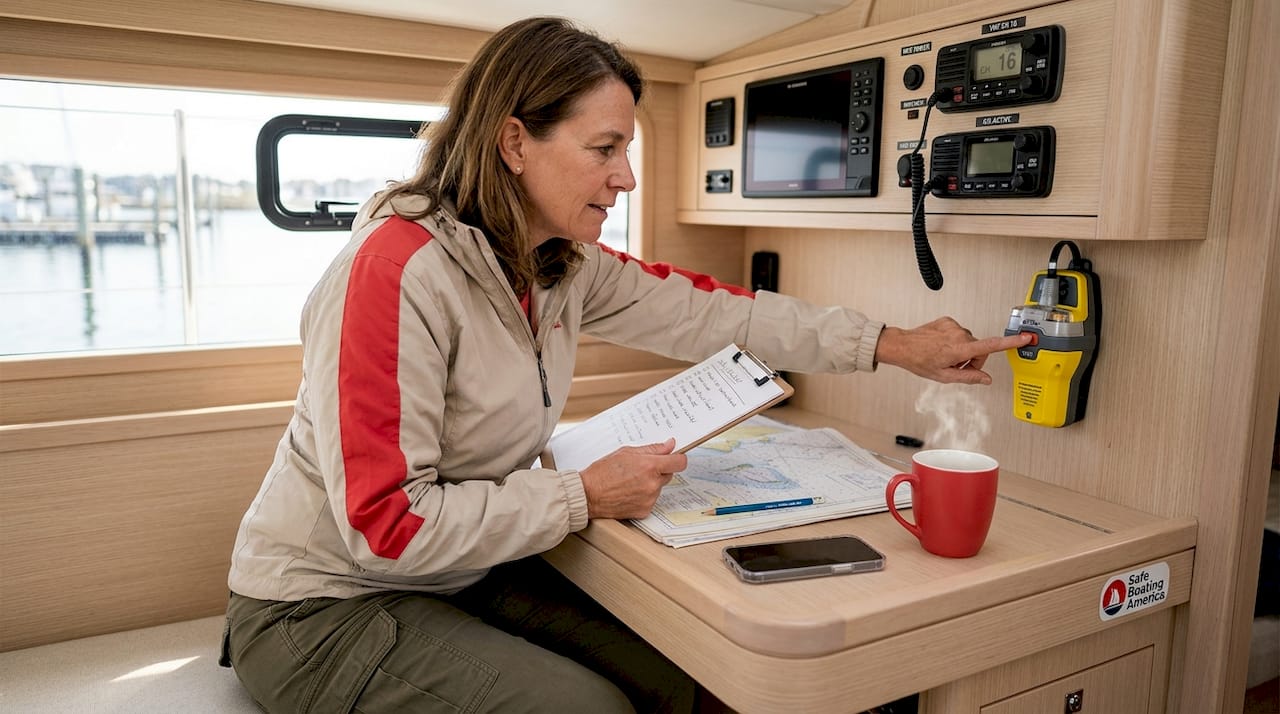
EPIRB maintenance requirements are the most specific and most frequently overlooked. USCG regulations require monthly testing using the integrated self-test circuit, battery replacement on the manufacturer’s schedule, and documentation of both. Failing to maintain these logs is a compliance violation, not just a safety lapse. The battery expiration date must be current, and the unit must be registered with NOAA and re-registered whenever ownership or vessel information changes.
Distress communication priorities carry legal weight. US law establishes absolute priority for distress communications and prohibits any transmission that interferes with distress frequencies. This applies to your VHF radio configuration and your operational habits. Channel 16 must remain monitored at all times when underway. Recreational boaters operating in international or offshore waters face additional requirements under international radio regulations.
A practical maintenance and compliance checklist:
- Monthly: Self-test EPIRB using integrated circuit. Log the date and result.
- Before each trip: Verify GPS signal acquisition on chartplotter and AIS. Confirm VHF radio powers on and scans Channel 16.
- Annually: Inspect all antenna connections for corrosion. Update firmware on chartplotter and AIS. Confirm EPIRB battery expiration date.
- Every two years or per manufacturer schedule: Replace EPIRB battery. Update NOAA registration if vessel or owner information has changed.
- After any incident: Inspect all electronics for water intrusion or physical damage before returning to service.
“Electronics that are not maintained are not safety equipment. They are false confidence. A failed EPIRB in an offshore emergency is worse than no EPIRB, because you may believe help is coming when no signal was ever transmitted.”
Boating certification courses, including Oregon PWC certification and similar state programs, teach students to pair electronic navigation with backup compass and chart skills. This redundancy is not outdated. It is a recognized best practice reinforced by the Bahamas boating regulation updates and USCG guidance alike. Electronics fail. Trained boaters with backup skills do not.
Staying current with federal boating regulations is the final pillar of electronics compliance. Regulations governing required safety equipment, radio licensing, and AIS carriage requirements are updated by federal agencies and individual states on irregular schedules. Subscribing to USCG safety alerts and reviewing your state’s boating law handbook annually keeps you ahead of changes before they become enforcement issues.
Pro Tip: Keep a laminated quick-reference card at your helm listing your MMSI number, EPIRB registration number, and the DSC distress call procedure for your specific VHF model. Under stress, even experienced boaters benefit from a physical reference.
A smarter approach: Beyond just buying the gear
Purchasing a full electronics stack does not make you a safer boater. It makes you a better-equipped boater. The gap between those two outcomes is filled by education, verification, and seasonal discipline.
The most common mistake we see is a boater who installs a Class B AIS transponder, confirms it powers on, and never verifies that it is transmitting a correct position. The unit appears functional. The chartplotter shows an AIS icon. But without confirming the GPS feed is active and accurate, the transmitted position may be wrong by miles. Other vessels see a ghost. Rescue teams would search the wrong area.
Real safety comes from understanding how boating education connects device operation to practical outcomes. Certification courses do not just satisfy legal requirements. They build the operational habits that make electronics work as intended. Students who complete NASBLA-approved courses learn DSC call procedures, GPS waypoint navigation, and EPIRB activation in structured, tested environments. That knowledge transfers directly to real emergencies.
Every season, before your first trip, run a full system verification. Power on every device. Confirm GPS acquisition. Transmit a test DSC call on Channel 70 using the non-distress test function. Check your EPIRB log. Inspect antenna connections. This takes less than 30 minutes and is the single highest-value safety action you can take before leaving the dock.
Electronics are tools. Tools require skilled operators and regular maintenance. Neither element is optional.
Get certified and boost your boating safety expertise
To put your electronics knowledge to the test and make it count for both safety and legal compliance, enroll in a structured boating certification course today.
Safe Boating America offers state-approved boating safety certification programs that cover VHF radio operation, GPS navigation, AIS awareness, EPIRB procedures, and PWC-specific requirements. Courses are taught by USCG-Licensed Captains and State Certified Instructors using NASBLA-approved materials.
Whether you prefer to study online, attend a live Zoom session, or complete an in-person class, flexible options are available nationwide. Local options like the Bethpage Boating Safety Class put you in a classroom with experienced instructors who connect electronics knowledge to real-world scenarios. Online boating courses provide the same NASBLA-approved curriculum with the convenience of self-paced study. Certification satisfies state requirements and builds the operational competence that makes your electronics investment count.
Frequently asked questions
Which boating electronics are required for recreational vessels?
Core requirements include a VHF radio, GPS/chartplotter, AIS for situational awareness, and EPIRB where applicable. For PWC operators, Pennsylvania regulations explicitly require a sound-producing device and engine cut-off switch safety lanyard as mandatory onboard equipment alongside a Boating Safety Education Certificate, and most states have adopted comparable standards.
How often should I test boating electronics like EPIRBs?
USCG regulations require monthly self-testing of EPIRBs using the integrated test circuit, with battery replacement on the manufacturer’s schedule and documentation of all tests kept for compliance review.
What makes AIS different from GPS or VHF radios?
AIS uses VHF frequencies and GPS input to broadcast and receive real-time vessel position, speed, and identity data. Class A units transmit every 2 to 10 seconds while underway, while Class B units update every 30 to 180 seconds, making update rate a critical factor in high-traffic situations.
Are backup navigation skills still important with advanced electronics?
Yes. USCG-aligned boating education teaches GPS and electronic navigation alongside traditional chart and compass skills, because electronics can and do fail, and trained redundancy is the recognized standard for safe vessel operation.
Do distress signals take priority over other radio communications?
Yes. US law establishes absolute priority for distress communications and requires all operators to avoid any transmission that interferes with distress frequencies, making proper VHF configuration and Channel 16 monitoring a legal obligation, not just a best practice.